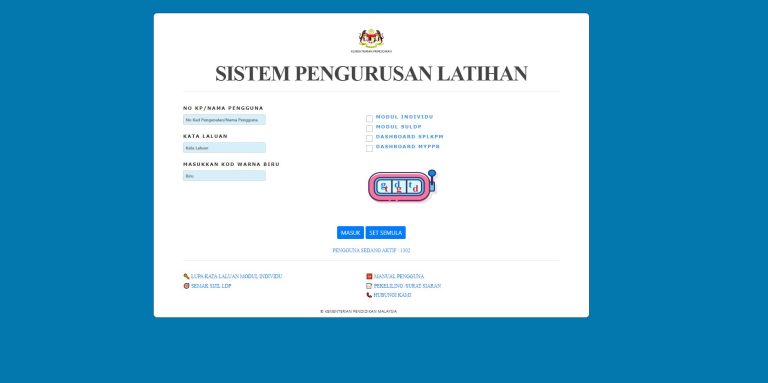
SPLKPM atau Sistem Pengurusan Latihan KPM merupakan portal yang dibangunkan khas oleh KPM bagi mengakses Sistem Pengurusan Latihan Guru atau SPLG – Pelbagai aktiviti boleh anda tambahkan ke dalam ePembelajaran, termasuklah yang terbaru – AI Untuk Rakyat.
Berikut dikongsikan panduan bergambar bagaimana untuk mengisi pembelajaran kendiri dalam sistem pengurusan latihan Kementerian Pendidikan iaitu SPLKPM.
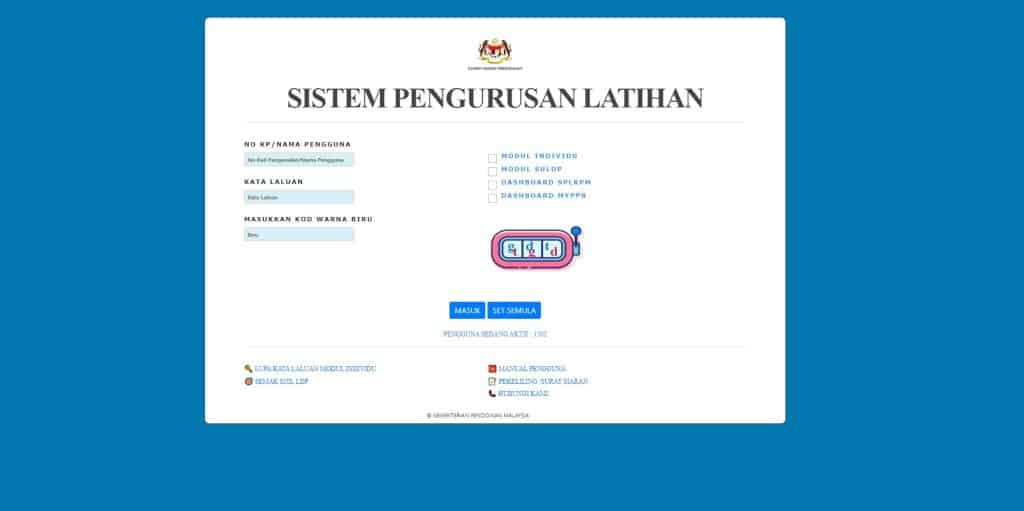
Pengenalan SPLKPM
Secara ringkasnya, SPLKPM digunakan untuk mendaftarkan dan merekodkan mata e-pembelajaran SPLKPM.
Dahulunya, sistem ini dikenali sebagai e-SPLG (Sistem Pengurusan Latihan Guru), di mana ia telah ditambahbaik dengan mewujudkan sub modul CV dan sijil online.
Sub modul bagi Modul Individu mengandungi elemen berikut:
- Sub modul Pelaporan – Rekod kursus / LDP yang disertai
- Sub modul Sijil Online – Cetak sijil secara online
- Sub modul eProfil – Kemaskini profil diri
- Sub modul CV – Semakan curriculum vitae
Objektif utama sistem ini adalah:
- Membantu mengiktiraf penyertaan PPP serta PPB dengan memberikan mata kredit bagi setiap aktiviti yang dijalankan
- Menggalakkan pihak yang terlibat untuk meneroka lebih banyak platform yang bersesuaian dengan profesion dan kemampuan, sekaligus meningkatkan kualiti perkhidmatan mereka
Ianya sedikit berbeza berbanding sistem eOperasi dan APDM di mana sistem ini lebih memfokuskan latihan dan modul individu yang diterima guru sama ada kursus, PLC, bimbingan dan pementoran, ulasan buku, lawatan kerja, bengkel, seminar atau kolokium, kajian tindakan dan penyelidikan, portal e-guru, perkongsian ilmu serta penulisan dan penerbitan.
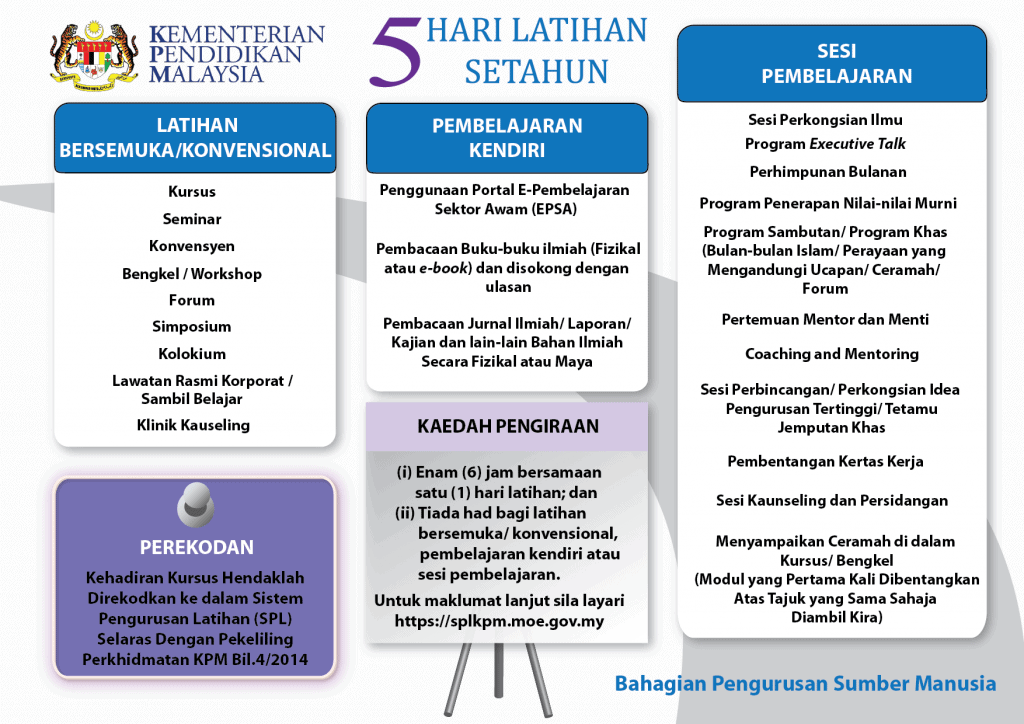
PERKONGSIAN : CARA UNTUK MENCUKUPKAN 5 HARI LATIHAN DAN 42 MATA CPD / PPB
- Book review – Dapat jam latihan dan mata CPD
1 buku = 1 hari = 6 jam = 6 mata
4 buah buku (4 hari latihan + 20 mata )
max = 20 mata ppb - E pembelajaran – Dapat mata ppb + jam latihan
1 jam ldp = 1 mata
max – 15 mata
Epsa/portal eguru /AKPK/ webinar/ portal e guru
Webinar dalam splklm sahaja
1 jam kursus = 1 jam ldp = 1 mat a ppb - Sumbangan
-Key in sumbangan bg guru yg terlibat dgn koko peringkat ppd/jpn/kpm – 1 sumbangan (5 mata) >>> cth : teknikal sofbol, bola sepak, olahraga (key in sekali je walaupun program berhari2)
-Key in sumbangan bg JU PPDPP / JU JPN / JU KPM
-Key in sumbangan bg AJK PIBG 2020
1 sumbangan = 5 mata - PLC…Mana2 panitia yg telah menjalankan PLC, ketua mohon key in di dalam splkpm . Pastikan key in IC ahli sekali.
Plc – dpt mata ppb shj
1 PLC = 5 mata
max – 20 mata (4 plc) - Pentadbir boleh key in Bimbingan dan pementoran dlm SPLKPM
B&P – dpt jam ldp + mata ppb
1 jam = 1 mata ppb
0.5 jam = 0.5 mata ppb - Taklimat / ceramah / dialog prestasi dll
Dpt jam ldp + mata ppb
1 jam = 1 jam ldp = 1 mata ppb
max utk taklimat/ ceramah/dialog = 15 mata - Bengkel / kursus – dpt jam ldp + mata ppb
1 jam ldp = 1 mata
max mata – 15 mata - Inovasi – Dapat mata ppb sahaja
1 inovasi = 10 mata
max – 20 mata - Peningkatan akademik – Dapat mata ppb – utk thn semasa ikut sijil
sijil – 4 mata
diploma – 8 mata
degree – 12 mata
sarjana – 16 mata
phd – 20 mata - Penyelidikan – Dapat mata ppb sahaja
1 kajian – 10 mata
max – 20 mata ppb - Penulisan/pengkaryaan kreatif – Dapat mata ppb shj
penulisan buku – bukan tugas hakiki sekali shj – 20 mata
artikel/jurnal – 10 mata
buletin – 10 mata
penghasilan modul (ciptaan sendiri) – 10 mata
seni kreatif – bukan hakiki ( muzik, visual, fotografi, tari) – 10 mata - Lawatan penanda aras dpt jam ldp + mata ppb
1 jam = 1 jam ldp = 1 mata
max – 10 mata - Program sangkutan – dpt mata ppb shj
1 program – 5 mata
*Sumber : Facebook
Penambahbaikan SPLKPM 2024
Untuk tahun 2024, SPLKPM telah membuat banyak penambahbaikan yang bagus. Banyak sangat e-pembelajaran yang sudah ditambah dan boleh direct link ke site tersebut melalui SPLKPM sahaja, contohnya AI Untuk Rakyat.
CARA MUDAH MENDAPAT MATA UNTUK E- PEMBELAJARAN
KURSUS EPEMBELAJARAN PKJR
Caranya :
- Klik http://epkjr.gov.my
- Daftar sekarang
- Masukkan maklumat yg diminta.
- Ambil link yg diberi di dlm email.
- Jawab soalan
- Tonton video kursus
- Pastikan kena skor 5 markah keatas utk task seterusnya.
- Sijil akan diberikan.
- Tambah aktiviti dalam e-pembelajaran SPLKPM
- Serah pada SULDP sebagai bukti penyertaan.
KURSUS DALAM TALIAN E-LATIH
- Klik https://elatih.hrdcorp.gov.my/
- Klik REGISTER
- Masukkan details – create account
- Pilih courses – klik enroll now
- Ikut modul tersebut sehingga 100%
- Setelah selesai – get certificate
- Tambah aktiviti dalam e-pembelajaran SPLKPM
- Serah pada SULDP sebagai bukti penyertaan.
KURSUS CDL – CONNECTING DOTS LEARNING
- Layari https://www.connectingdots.my
- Sertai kursus CDL HANDS-ON ONLINE SESSION yang diadakan setiap minggu.
- Ikuti sehingga akhir siaran dan dapatkan e-sijil
- Tambah aktiviti dalam e-pembelajaran SPLKPM
- Serah pada SULDP sebagai bukti penyertaan.
TERKINI : Cara Daftar AI Untuk Rakyat Dalam SPLKPM
Merujuk kepada surat siaran JPA.KPPA/016 JLD18 (52), semua penjawat awam dikehendaki melengkapkan Program Pembelajaran ‘AI Untuk Rakyat’ secara dalam talian iaitu ‘AI AWARE’ & ‘AI APPRECIATE’ – Guru yang telah melengkapkan program ini boleh membuat kunci masuk ke dalam SPLKPM.
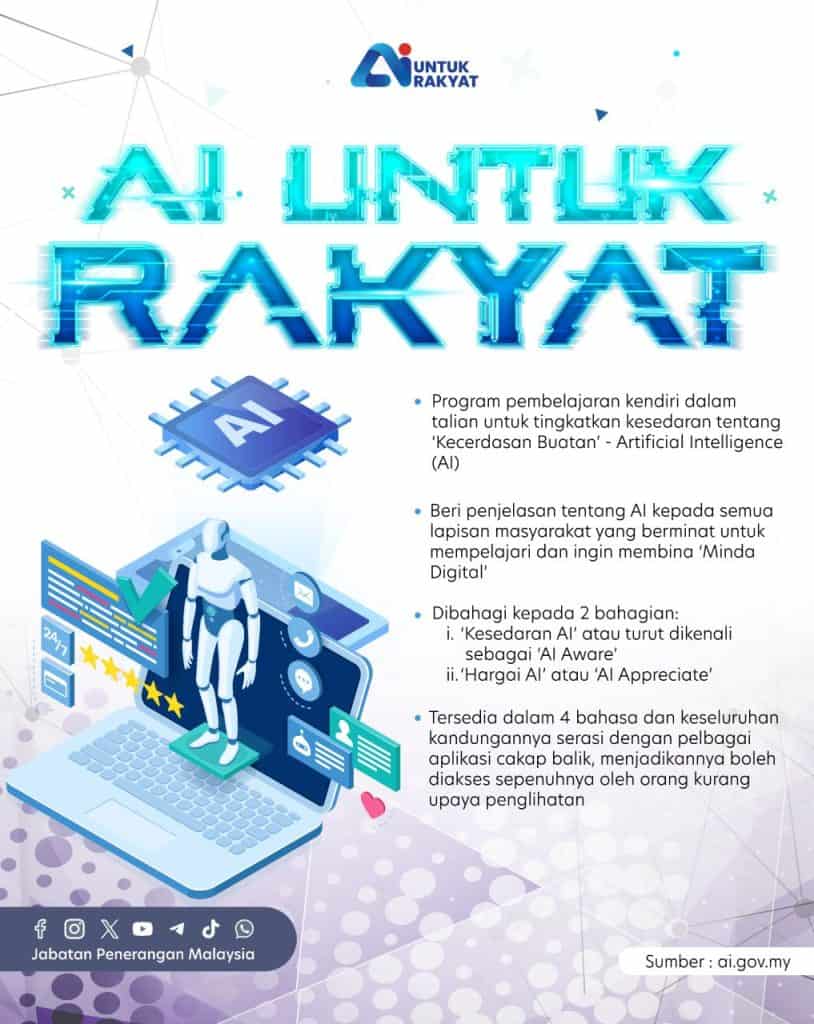
*Untuk mengetahui lebih lanjut cara untuk menyertai modul AI Untuk Rakyat, sila rujuk : AI Untuk Rakyat – Daftar Modul & Jana Sijil Lencana Digital
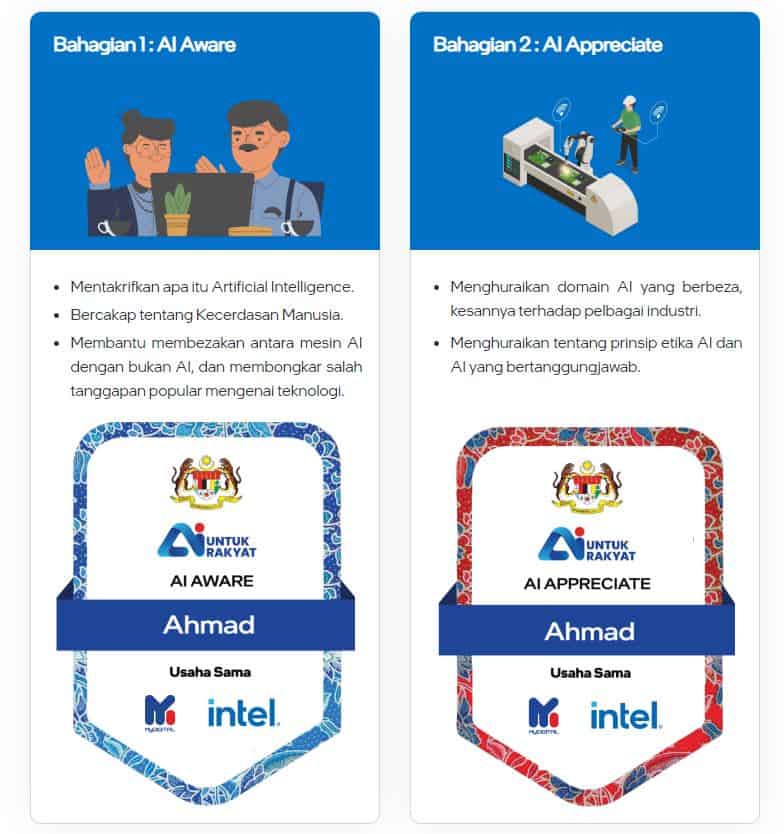
Setelah lengkap pembelajaran tersebut, anda boleh claim lencana AI Aware & AI Appreciate serta anda boleh mendaftar e-pembelajaran di laman SPLKPM dengan tempoh pembelajaran selama 4 jam.
Cara daftar AI Untuk Rakyat dalam SPLKPM :
- Login masuk splkpm modul individu https://splkpm.moe.gov.my
- Pembelajaran kendiri – ePembelajaran
- Tambah aktiviti
- Pilih L1 – PDP
- Pilih Kemahiran digital
- Kemahiran literasi media dan maklumat
- Ai untuk rakyat
- Klik pada Ai Aware
- Simpan
*Ulang semula step & daftar untuk AI appreciate. - Masa utk setiap bahagian adalah automatik.
- Jumlah jam
- AI aware – 1.5 jam
- AI Appreciate -2.5 jam
- Tunjukkan badge pada SU untuk pengesahan anda sudah selesai
- Jumlah jam
PANDUAN BERGAMBAR
Setelah selesai menjawab kuiz, sila log masuk ke SPLKPM untuk rekod e-pembelajaran anda.
Klik pada ikon e-pembelajaran dan tambah aktiviti.
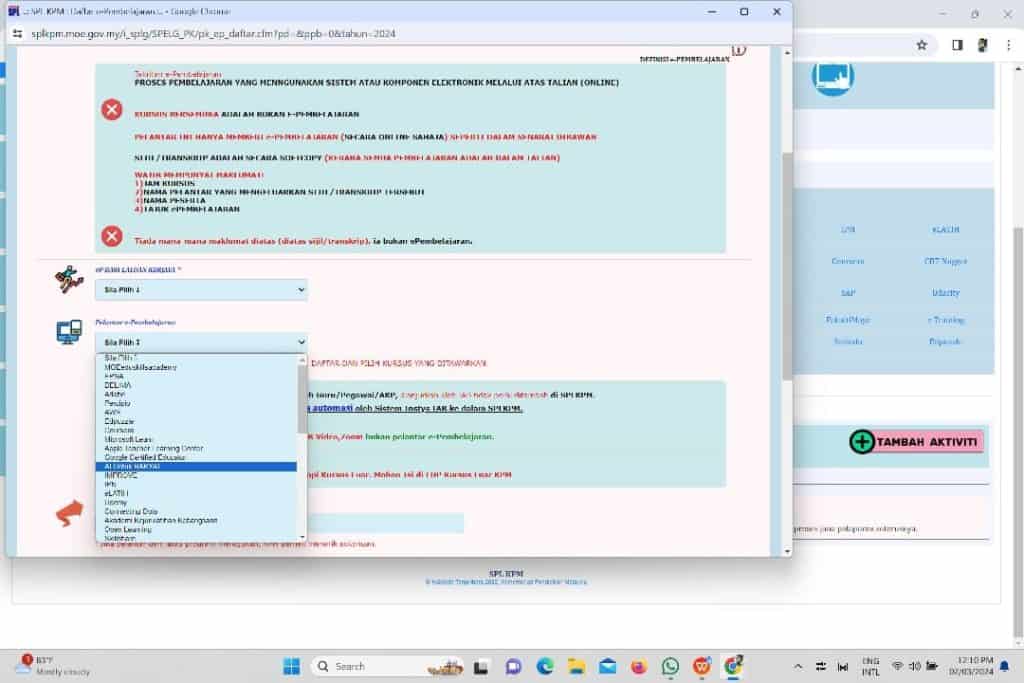
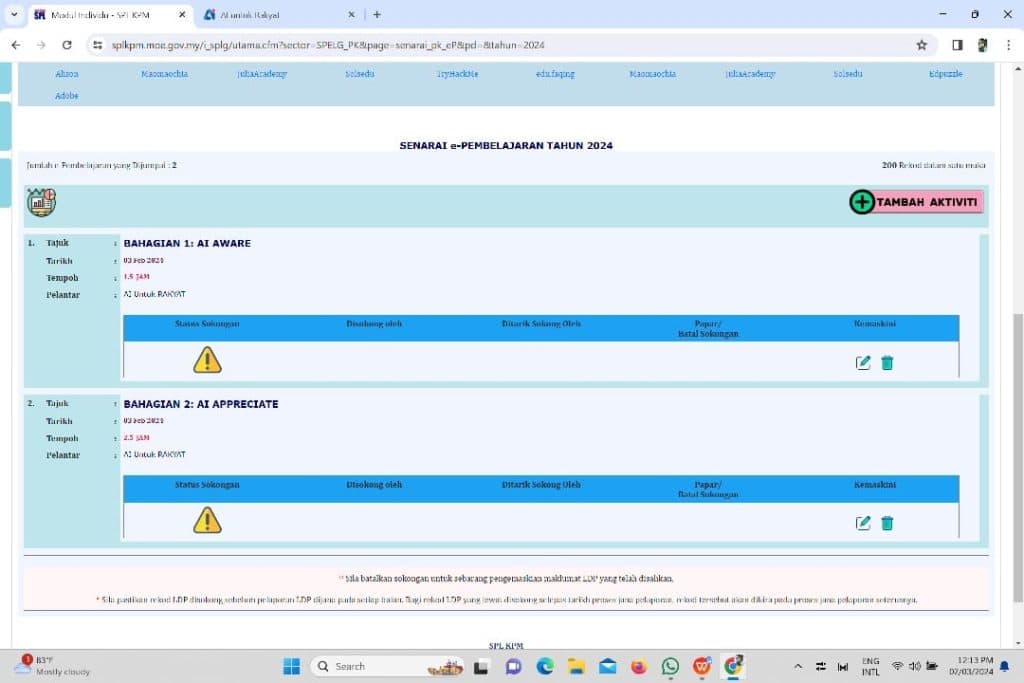
Isi maklumat yang berkaitan. Isi AI Aware dahulu. Kemudian tambah aktiviti lagi untuk AI Appreciate.
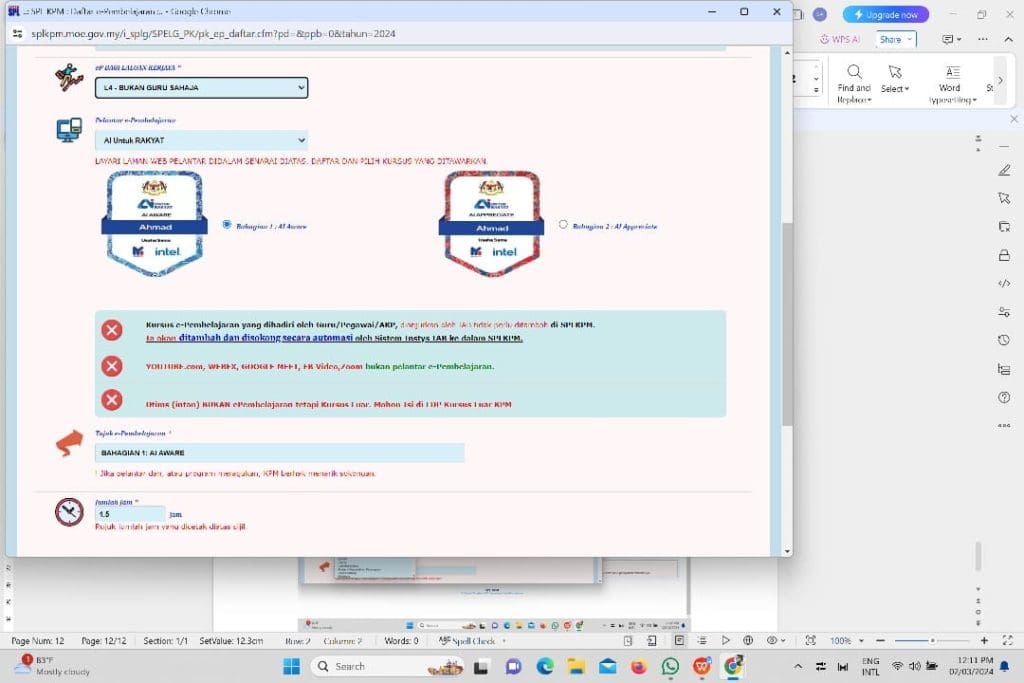
Anda akan mendapat 1.5 jam untuk AI Aware & 2.5 jam untuk AI Appreciate. Jangan lupa maklumkan kepada admin / penyelaras jabatan / sekolah masing-masing untuk sokongan.
Share gambar lencana yang diperolehi secara personal kepada admin sebagai bukti.
Panduan Tukar Kata Laluan Baru SPLKPM
Untuk makluman semua warga KPM, Portal SPLKPM telah dikemaskini dengan ciri keselamatan yang baharu.
Pengguna perlu menukarkan kata laluan yang lebih kuat untuk log masuk terkini.
Sila rujuk video di bawah:
Dilampirkan panduan untuk log masuk portal SPLKPM terkini (PDF).
- Panduan PDF : https://drive.google.com/…/1QiYq…/view…
- Panduan Video : https://drive.google.com/…/16s7AZ2negNh3jglyM6o…/view…
- Panduan Slaid Canva : https://bit.ly/PORTALSPLKPM
Sumber: SULDP
Login SPLKPM Di splkpm.moe.gov.my
Langkah 1
Akses log masuk portal SPLKPM melalui https://splkpm.moe.gov.my/
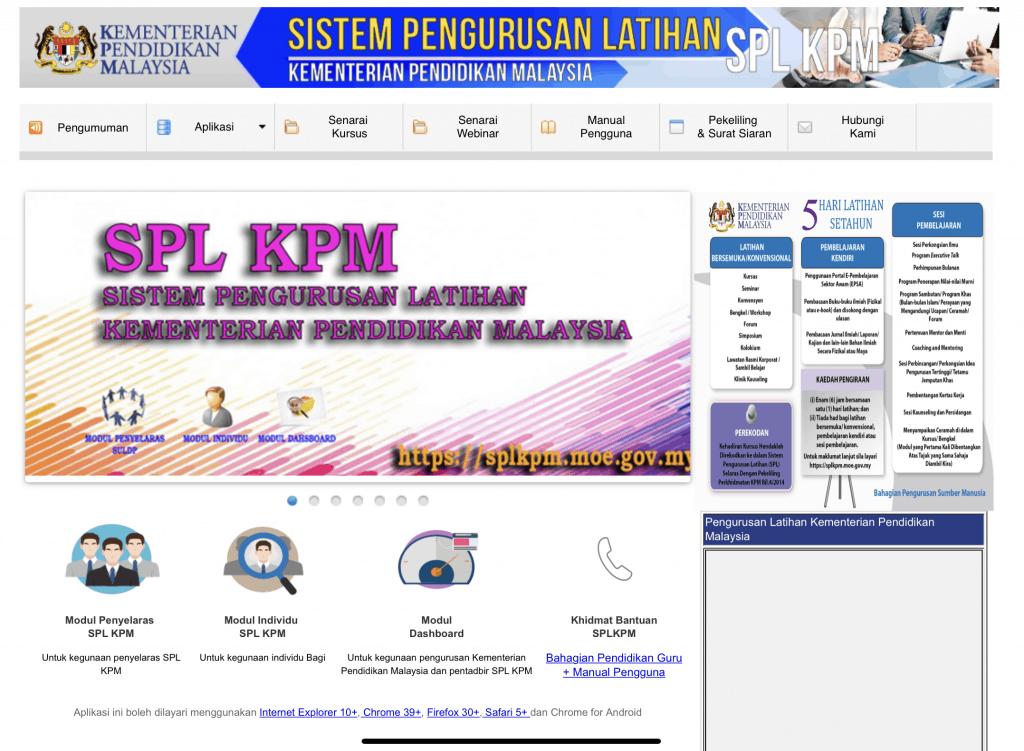
Langkah 2
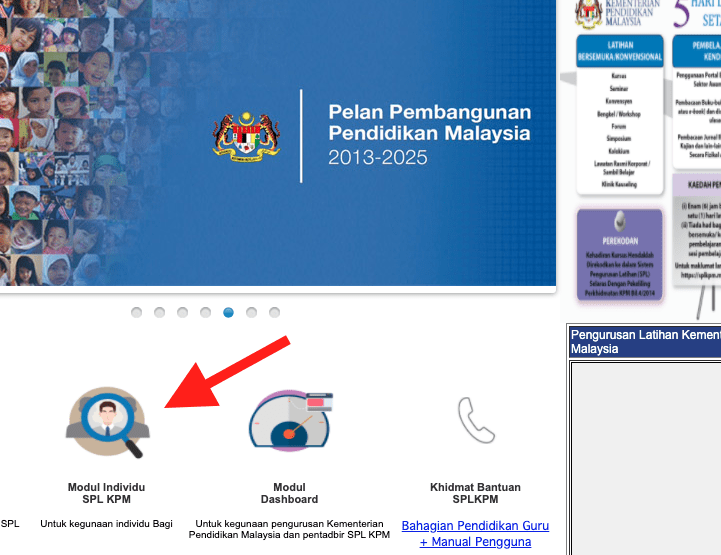
Pilih login SPLKPM Modul Individu
Langkah 3
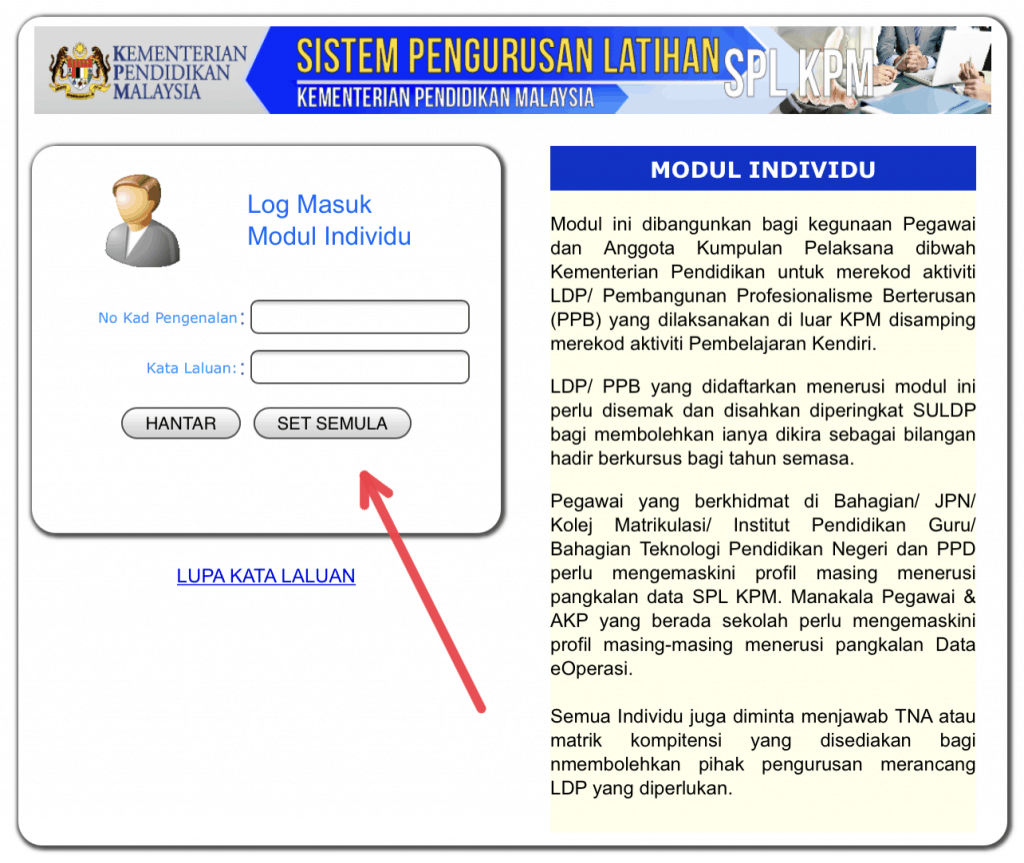
Masukkan ID (no kad pengenalan) dan password
Anda terlupa kata laluan?
Sekiranya terlupa kata laluan, anda boleh klik “Lupa Kata Laluan” untuk set semula password.
Sila tukar kata laluan yang senang ingat atau catit di dalam telefon.
Langkah 4
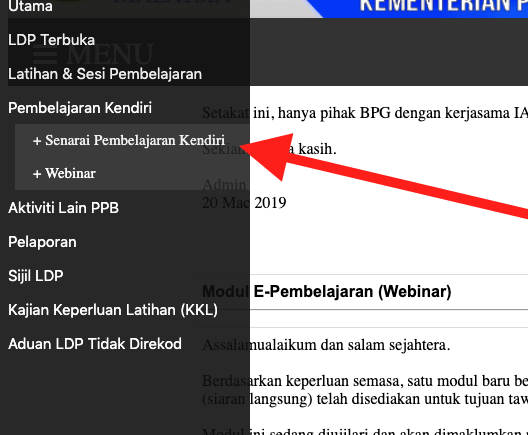
Pilih “Pembelajaran Kendiri” pada menu sebelah kiri. Kemudian pilih “Senarai Pembelajaran Kendiri”.
Langkah 5
Tutup menu dan pilih “e-Pembelajaran”
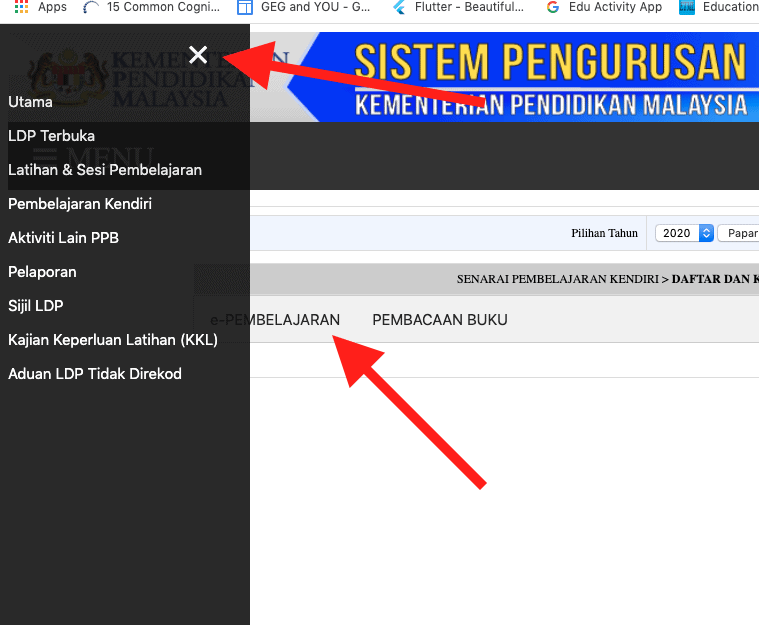
Boleh juga klik Pembelajaran Kendiri sekiranya berkenaan di dalam sistem SPLKPM.
Langkah 6
Pilih “Tambah Aktiviti” SPLKPM
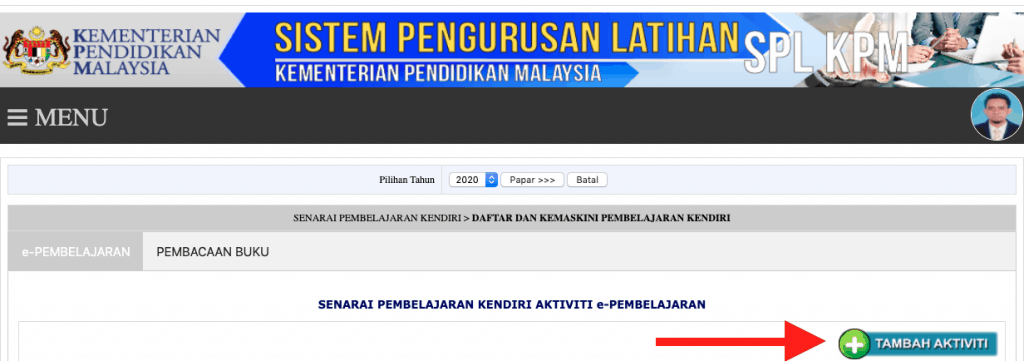
Untuk tambah aktiviti, sila klik tambah aktiviti dan masukkan perkara yang berkenaan.
Langkah 7
Lengkapkan butiran dan simpan.
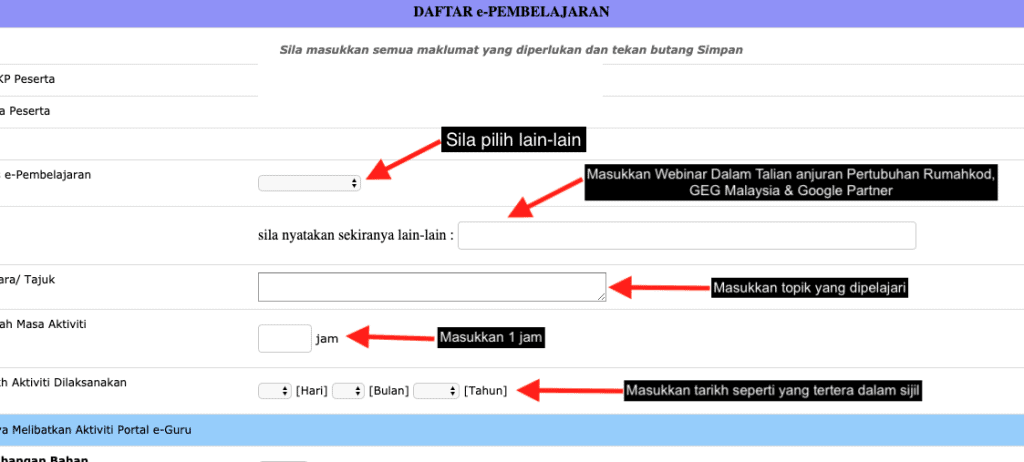
Borang
PTM (e-Pembelajaran)
Pekeliling & Surat Siaran
Rujuk Manual Penuh di SINI. SEMAK SIJIL LDP
Senarai Kursus Online SPLKPM
Terdapat pelbagai senarai kursus dan webinar tahunan yang boleh anda kemaskini di SPLKPM.
Antaranya ialah:
1. Kursus SPL KPM AKPK
- KURSUS SPL KPM EPSA
- Link Kursus EPSA : https://www.epsa.gov.my/
- KURSUS ELATIH : https://elatih.hrdcorp.gov.my/
- Latihan Melalui E-Pembelajaran melalui Webinar, Plc dalam talian termasuk kursus lain dalam pelantar E-Pembelajaran boleh di daftar terus dalam SPLKPM melalui Modul Individu
- KURSUS GOOGLE EDUCATION
- KURSUS PKJR : http://epkjr.gov.my
- KURSUS MICROSOFT EDUCATION
- Microsoft Education menawarkan beberapa kursus dengan sijil penyertaan. Sila daftar hadir secara online di sini, https://education.microsoft.com/en-us
- KURSUS DIGITAL CLASSROOM
- Melalui Digital Classroom Malaysia, ada banyak kursus webinar live streaming online untuk anda hadir dan pelajari yang boleh daftar.
- E-DIDIK MALAYSIA
- eDidik Malaysia sering promosi bengkel / kursus percuma yang sering melalui https://sites.google.com/edidik.edu.my/edidik-malaysia/laman-utama.
Diharapkan perkongsian cara daftar dan kemaskini SPLKPM login modul individu ini dapat membantu anda menambah dan memaksima mata kredit terkumpul dalam sistem, sekaligus menambah ilmu untuk diaplikasikan semasa berkhidmat nanti.
Dapatkan Canva Pro dengan harga serendah RM1.00 di SINI.